


Seneca Lake’s Economy
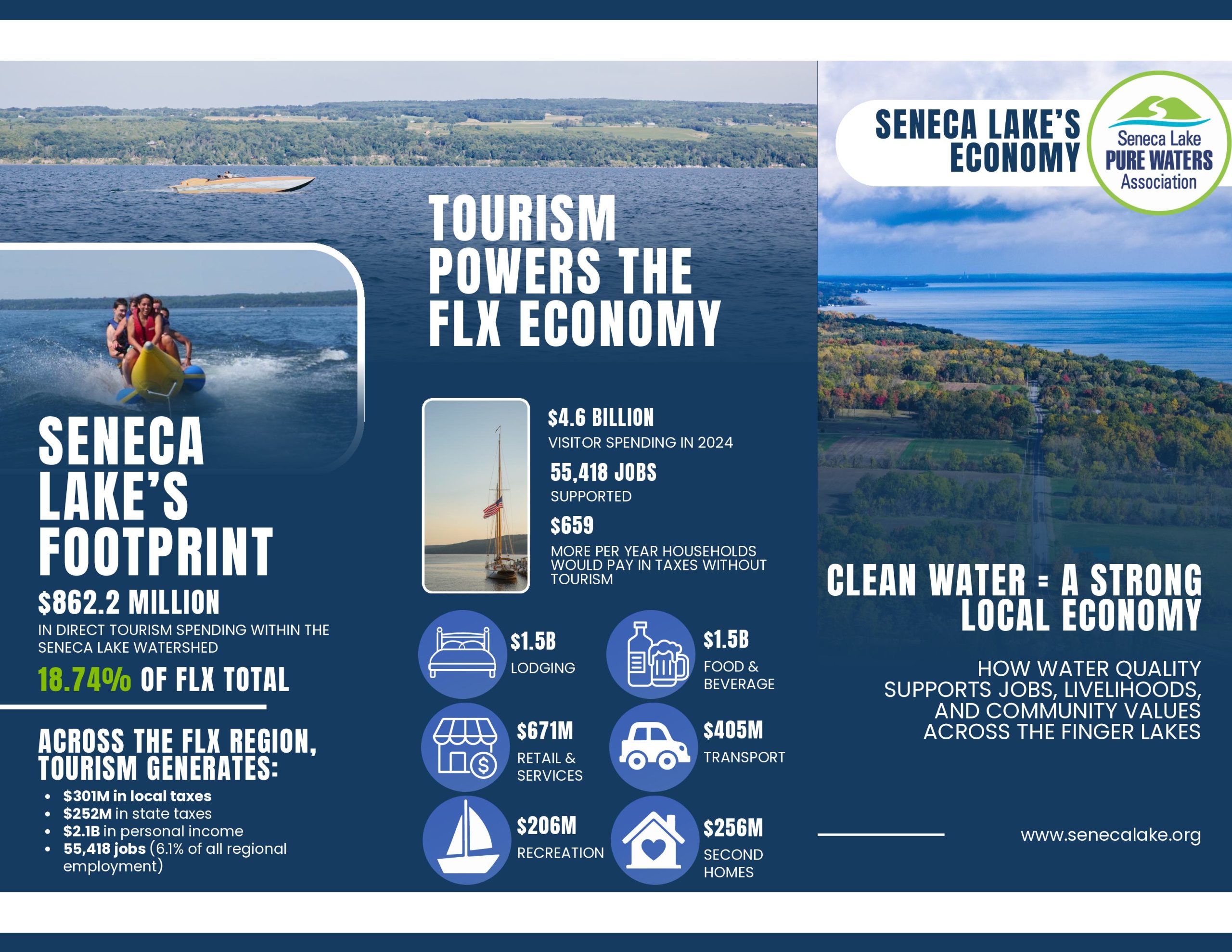
The Seneca Lake watershed is a cornerstone of the Finger Lakes regional economy, generating $862.2 million in direct tourism spending in 2024, nearly one-fifth of the entire FLX total. Tourism across the region supports 55,418 jobs, produces $4.6 billion in visitor spending annually, and saves the average household $659 per year in taxes that would otherwise be needed to fund local government services.
Tourism spending within the Seneca watershed breaks down across several categories: lodging accounts for $303.5 million, food and beverage for $292.1 million, retail and services for $94.5 million, second homes for $90.3 million, entertainment and recreation for $44.3 million, and transportation for $35.9 million.
Seneca Lake’s watershed represents a disproportionately large share of regional tourism value. While encompassing roughly one-fifth of FLX visitor spending, the watershed accounts for 17.85% of regional tourism employment (9,894 jobs), 17.35% of personal income ($364.4 million), and nearly 20% of state tax revenue generated by tourism: $50.2 million in 2024.

Tourism is deeply connected to agriculture across the watershed counties.
Ontario County alone sees $324 million in agricultural product sales annually, with 42% of its land in agricultural use. Yates County’s farms generate $152 million in market value, and Schuyler County contributes $68 million, with dairy as the dominant sector across most counties.
Property values reflect the health of the regional economy. Median home prices across the five watershed counties have risen substantially. Ontario County’s typical home value has increased from roughly $223,000 to over $302,000 in recent years, and average salaries in the region have grown from the mid-$30,000s to mid-$60,000s and above since 2015.
Tourism by county illustrates the breadth of the lake’s economic footprint. Ontario County leads with $377 million in direct visitor spending (up 10.6% from 2023), driven by food and beverage, lodging, and retail. Seneca County contributes $186 million, with lodging as its strongest sector at $117.8 million. Yates County generates $102 million, with second homes playing an unusually significant role at $28.2 million. Schuyler County adds $80.6 million, anchored by outdoor recreation and lodging, while Chemung County contributes $116.6 million led by food, beverage, and transportation spending.
Clean water is the foundation of this economic value. Tourism relies on the appeal of Seneca Lake to draw visitors, support local businesses, and sustain livelihoods across the watershed. Agriculture, too, depends on clean water for productive farmland and livestock. Protecting Seneca Lake’s water quality is not simply an environmental priority, it is an economic imperative for every household, business, and community that benefits from the lake’s presence.